
World Tuberculosis Day: Interview with Timo Ulrichs
The replenishment campaign of the Global Fund to Fight AIDS, Tuberculosis and Malaria ended at the beginning of this year, securing 12,64 billion US dollars for the next three years, against an estimated need of 18 billion US dollars for the upcoming cycle. Drastic international cuts in official development assistance have had a devastating impact on donor countries’ pledges to the Global Fund.
In 2024, 1.2 million people died from tuberculosis out of the 10.7 million who developed the disease. The Global Fund provides 73% of all international financing for the fight against tuberculosis.
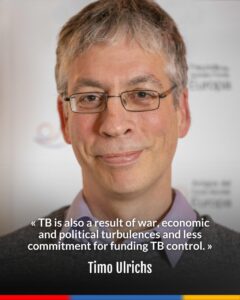
On the occasion of World Tuberculosis Day, we give the floor to Timo Ulrichs, a microbiologist and immunologist specializing in tuberculosis, founder of the Koch-Metchnikov Forum in Germany, and member of Friends of the Global Fund Europe’s Advisory Committee.
Over recent years, several high-income European countries have slashed budgets allocated to solidarity with low- and middle-income countries, while simultaneously increasing defence budgets. As a result, partner countries of the Global Fund, the largest financing institution to fight pandemics that provides 73% of all international financing for tuberculosis (TB), are facing an average 20-30% reduction of their allocations compared with 2024. What consequences do you foresee in terms of the risk posed by tuberculosis to global health security, and to public health in Europe specifically?
If we consider that in addition to the overall cuts in financing for TB, many HIV/AIDS control programs had to be shut down because of services disruptions, we will see a global increase in both HIV – and even AIDS – cases and TB as opportunistic infections. The coronavirus pandemic caused a shift of financial and health resources toward fighting the virus – and away from TB control programs – resulting in an increase in TB cases, even in the WHO European Region, which is also currently facing multidrug-resistant TB and neglected national TB programs due to the war Russia has waged against Ukraine.
TB is also a result of war, economic and political turbulences and less commitment for funding TB control.
The war Russia waged against Ukraine had a major impact on TB diagnostics and treatment pathways in both Ukraine and Russia. In Ukraine, our collaborating partners in Western Ukraine informed us about decreasing patient adherence, increasing resistance patterns per clinical isolate and temporary shortages of anti-TB drugs in some regions.
The overall emergence of multidrug and extensively multidrug resistant strains of Mycobacterium tuberculosis is increasing. As we ended partner projects in TB control (and even communication) with our scientific partners in Russia, we have no direct information about the TB situation there. However, an exacerbation of both M. tuberculosis and HIV in the Russian population has to be assumed.
Last February, WHO recommended new diagnostic tools and methods, that are 10 times cheaper than pre-existing tools, and that can, unlike their predecessors, be used to effectively diagnose TB among infants and young children, as well as among people with low immunity, who are both disproportionately prone to fall sick and die of active TB. AI is also being increasingly used to increase the efficiency of X-ray screening and diagnosis. In your view, can these innovations in TB diagnostics be considered as game-changers?
Yes, they can. But only, if their implementation will be supported both logistically and financially by the TB control community headed by the Global Fund. The Foundation for innovative new diagnostics (FIND) serves as a good example to also include private companies in efficient TB control. Efficiency is very important in our days as financing resources are decreasing.
As an example, TB diagnostics in poor countries of the WHO European Region, e.g. in the Republic of Moldova, could be supported by these new tools. Automatization and digitalization are already installed, so that an interoperability would be available.
BCG vaccination effectively protects children from dying of TB until 10 to 15 years of age, but does not offer protection to adolescents or adults after close exposure. New TB vaccines candidates could become available as early as end 2026. What to expect, and not to expect, from upcoming new TB vaccines? What priorities do you see for research and development against TB moving forward?
Indeed, there are some interesting new vaccine candidates in the pipeline. However, it is questionable whether they will turn out as game changers. In the fight against TB, we have to reach pre- and post-exposure protection. And immunity to the intracellular pathogen M. tuberculosis is so complex that we will have to invest more research into a better understanding of host-pathogen interactions. As a new approach, mRNA-based vaccines could add to developing new concepts in protection against infection and disease caused by M. tuberculosis, perhaps a heterologous prime-boost combined vaccines (of more than one candidate or combined with BCG) might be promising.
For instance, the current situation in the WHO European Region would benefit very much from a protective vaccine: fighting multidrug-resistant TB, decreasing work load for diagnostics and treatment, adding to TB control in Ukraine, establishing new pathways of TB prevention. However, instead of waiting for a protective new vaccine, we should concentrate our efforts and resources in working concepts, namely strengthening national TB programs (funded by the Global Fund) and also strengthening surrounding healthcare structures. And, most of all, ending wars and poverty, as both support TB spread.
Anything you want to add?
Facing multiple crises (the war in Ukraine, many additional military conflicts, increased migration due to conflicts or climate change consequences, economic turbulences, effects of climate change also in Europe), we should consider TB not only as a health problem, but also as a security problem: any decrease in TB control efforts will result in strong increases in (multidrug-resistant) TB spread in the nearer future and in adding to the problem of antimicrobial resistances that is considered to become the most important health challenge in the coming years.